When they were discontinued, I was allowed to take some of them home. Had to give them up, though, because I lacked the room to keep the boxes around, and at the time I also lacked the time to maintain software or investigate hardware upgrades.
The saddest thing for me is that today I would love to have kept the enclosures and PSUs (I’d likely have stuffed them full of Raspberry Pi compute modules, or Celeron mini PC motherboards, and hooked up an MCU to the display and buttons…)
But some of them were online and running at my former employer until 2018 or so, which is nothing short of amazing.
Thanks for unlocking a memory for me. I used to drool over that hardware, not even for the specs but just how cool it looked. I'm sure it's prohibitively expensive but maybe I'll find a good deal on ebay.
In the early 2000s I worked for a streaming media company where most of the desktops were AMD K6-2 450s. Except mine, because I splashed out and bought a Duron 700 with 256MB of RAM which I soon upgraded to 512MB, and fitted an ATI Rage 128 Pro, with the thick purple dangly-dongle for AV connections, and a FireWire card for capturing DV. Quite the beast for running Adobe Premiere 4!
Something about the sticker placement and black lettering directly applied to the metal cover, I've never seen another hard drive with a similar aesthetic.
Those drives worked well, I still have a 40gb IDE PATA Quantum Fireball out in the garage and about 3 years ago I tested it and this baby still worked!
Funny how my brain latches onto the seemingly randomest things and patterns, but for stuff I want to actually remember, it can be a struggle..
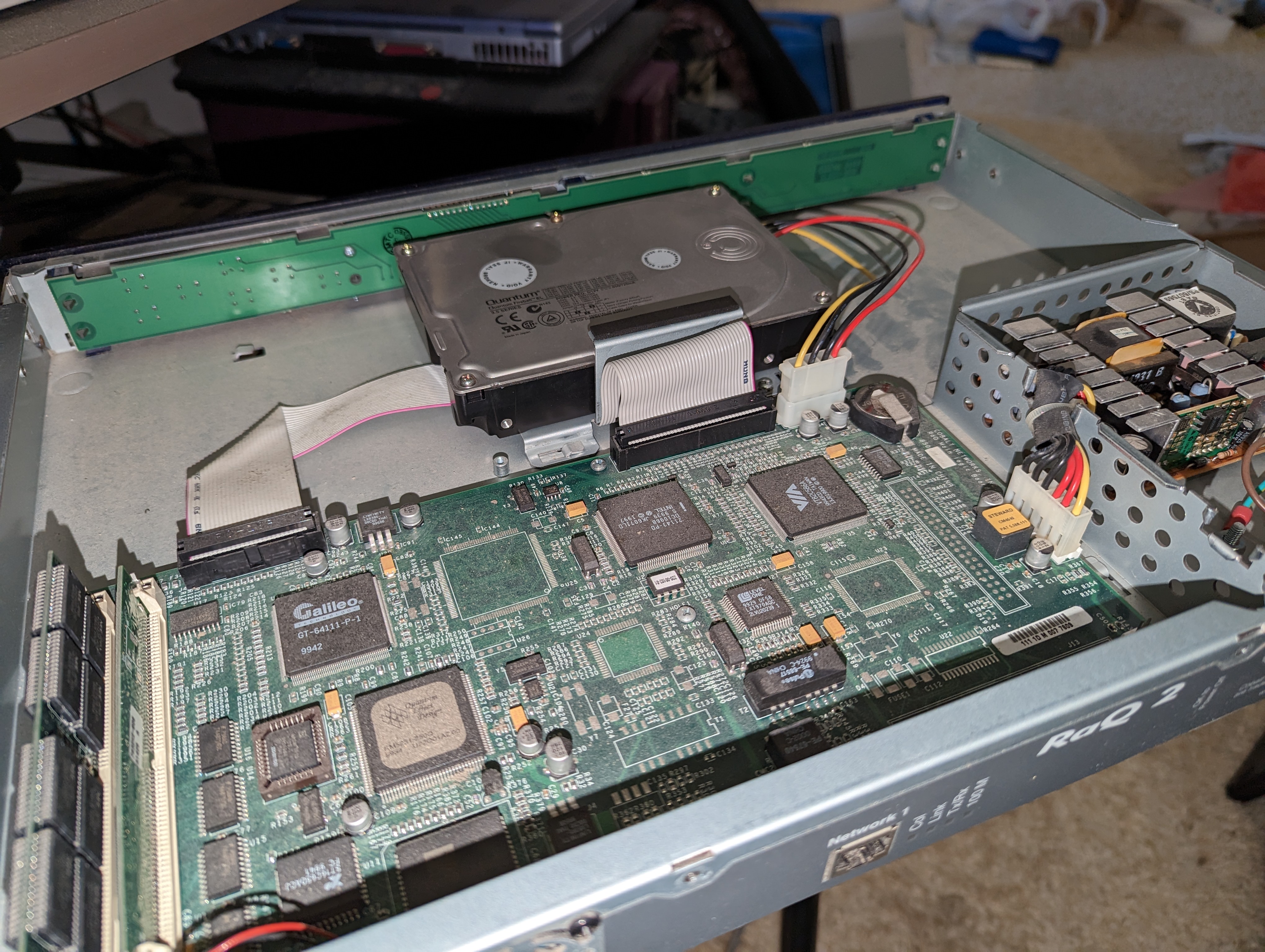
These machines have several things that we don't see much these days: "Made in USA", which the author mentions, a CPU that takes so little power that it doesn't require a heat sink, and a low power design that means the whole system doesn't even need a fan at all. Some have fans, and some come without fans.
The hardware is incredibly reliable. I've been running one RaQ for two decades now, and it has compiled continuously for years. It compiles all of the NetBSD binary packages for mipsel found here:
Another RaQ had a power supply that failed. I took a power supply from an old external drive enclosure, connected +5 and +12 volts, and everything worked. It's amazing how much can be done with so little power.
Probably. As a general rule, though, we use actual hardware where possible. There have been differences between real hardware and emulated machines, such as floating point issues with m68k in qemu, for instance.
At some point, though, some of these kinds of builds will move to qemu and friends.
As a former Cobalt employee, it made my day to see someone resurrecting old RaQs! What a fantastic piece of equipment for its time. I worked there in 1999 through the Sun acquisition and then at Sun for a little while before I started my own business—a web hosting company, started with a glorious rack of RaQs, of course. :)
Hi Erica! I was there as a Sales Engineer serving the southwest region around the same time you were there too (2000-2002), based in San Diego. I wish I had kept the RaQ and Qube units I had at home (I had pretty much one of everything from Qube2 through RaQ 550).
Cobalt was an awesome place to work and had amazingly skilled employees. Too bad the Sun acquisition was the death knell for the products...
Okay. Now I feel old.
I ran some hosting using these and the raq3’s over here in Ireland.
Such a bang for your buck. Comparable gear from compaq with the right kind of management tools to do the same hosting ran in six figures. And the raq rolled over them for feature sets and stability and most especially security. Loved those 1u’s. They were awesome. Even ran a radio station’s streaming via Real that was installed on one of them. Cobalt able to compile their own RPMs for the win.
A friend of mine had an early access Qube that we ran qmail on (back then I was an anti-Windows activist and a djb cultist.) The machine worked pretty well.
It fell down during the "Love Letter" virus attack and to get it back up I had to write a script that scanned the logs and inserted firewall rules to block virus-infected machines.
The worst problem it had was that the system clock ran 15% slow so it had to be resynced frequently with ntp.
I wish I had marked the calendar to commemorate the day we turned off the last of the Cobalts at a data center I worked in from 2003-2010. We had a suite that was almost entirely dedicated to them, rows of racks with nothing but Cobalt, thousands of them. Customers were so attached to them that they were happy to continue paying 1999 prices for hosting, so it was difficult letting go of those fat margins.
This brings back a lot of memories. Back before home labs or home automation were a big thing, I had a Cobalt RaQ I used to raise up my monitor an extra inch. With a few scripts I got the LCD to display alerts from our monitoring system at work, and wired one of the buttons to telnet to the timeclock system and clock me in/out so I didn't have to do paper time cards when I fixed stuff after hours.
This bought back a lot of memories for me as well, I used to work for a hosting provider in the early 2000's and we had dozens of these things both in our data centre and internally for development purposes. I hadn't thought about them for years but the second I saw this article title I had flashbacks!
I still have a perfectly working Cobalt Raq 550 sitting in my closet... Pentium III 1 GHz, 1 GB of RAM. Don't know what to do with it. It's also extremely noisy so can't use it as a server or router at home.
Alternatively, consider getting a cheap Celeron N5105 mini PC (or two - two should fit in the case) and adapting the PSU for it… Might be a fun project if you can do it non-destructively.
I had a pair of these for doing webhosting back in the day. I'd colo'd them at a sublet space in a New Orleans data center. Reliability got really spotty at one point - turns out the guy I rented the Us from had failed to pay his bill. We got kicked out and he took all the equipment (about 3 full racks) and piled it into his car. He then took it to his pool house where he'd had a T1 line dropped in. He owned the IP block, so they didn't need to re-address anything. I only found out why things were so slow when I demanded to come get my hardware.
Sadly, not my worst colo experience. That went to a Texas-based, name brand "dedicated server" operation who had a secondary site in Chicago. I bought a server there solely for offsite backups; it was plagued with issues. Turns out, the data center was the scene of constant theft - by the employees. It came to a head one night when off-the-clock employees injured the on-duty employee, cut a hole in the wall, and then made off with all sorts of networking and computing gear. The company lied for months, held data hostage, and kept money for services they didn't provide. I think Chris Faulkner is still in jail now, so he can't make good on his threats to sue me now. Dude got really pissed when customers told the truth on Web Hosting Talk. I hope he enjoys every last minute at FCI LOMPOC.
A friend and I worked at a mini ISP of sorts, a customer had one but upgraded to something else so they just said we could have it.
I wasn't there that day so he got to take it home. He kept it on a shelf on his desk, and he would run his php code on it, it was such a cool little setup at the time.
I ended up eventually getting a retired RedRak from another customer, so I wasn't jealous anymore.
I picked up a RaQ 3 some time ago after haggling an eBay seller down to about $40. I was intending to run Windows NT 4 on it for some very legacy devices in my retro lab. But I hadn't got around to it yet
Wonder if it's still possible to upgrade it to an AMD K6-III as well
While the RaQ 3 had an x86 cpu, it doesn't have a normal PC bios. completely custom board and firmware made for booting a linux kernel which I think would be very-challenging near impossible to boot Windows on.
Talk about a weird internet moment. I see this listed on HN this morning as I'm doing the morning routine and I didn't even look at the link, I just clicked on it thinking "I used to have a RaQ2..." click
As I read the article, I realized I was on Cameron's site and that this particular RaQ2 used to be in _my_ garage. (Hey, I'm slow in the mornings since I cut out caffeine.)
Super cool to see it still in operation, and always dig reading Cameron's latest adventures in old hardware. :)
I've been interested in putting one of the MIPS variants of these into service in my homelab, but I can't find a reasonably priced one. It seems the x86 ones are most common on ebay
I both love these and hated them. At The Planet (before the Softlayer founders left) we had a wall of these that were so neat to look at. My 16 year old self thought they must be the best.
These things taught me that a web based control panel is hard to do right. We had so many that I often needed to do something and used the web UI at first. That didn’t last.
The Planet was generous and let me rack one for myself but I ditched it for an old 2u running Solaris not long after.
These things were so insecure they were used to train script kiddies on basic hacking techniques. Many fond memories of ".... wait, wtf?!" A simpler time...
I remember when they came out I thought, from a purely aesthetic perspective, that they look so cool. Just like the sound modules in my music studio (at the time).
I still have a Cobalt CacheRaQ (caching proxy server) and a Cobalt VelociRaptor (Firewall) (the blue Cobalt branded one from before they became Symantec products).


When they were discontinued, I was allowed to take some of them home. Had to give them up, though, because I lacked the room to keep the boxes around, and at the time I also lacked the time to maintain software or investigate hardware upgrades.
The saddest thing for me is that today I would love to have kept the enclosures and PSUs (I’d likely have stuffed them full of Raspberry Pi compute modules, or Celeron mini PC motherboards, and hooked up an MCU to the display and buttons…)
But some of them were online and running at my former employer until 2018 or so, which is nothing short of amazing.
In case someone is interested, I have a bunch of old resources here: https://taoofmac.com/space/com/cobalt
I also kept a copy of the hacking FAQ: https://taoofmac.com/space/com/cobalt/faq